Web · Improvements · E-commerce · UX · Performance
Almamed online store — ongoing improvements
Since 2021 we’ve run the Webasyst store: catalog UX and path to order, homepage upgrades, then a large 2026 speed pool — search, N+1, cache, and Core Web Vitals.
About the client
Almamed supplies medical equipment nationwide — direct manufacturer contracts and a wide range. The site runs on Webasyst. First we rebuilt template UX and the main storefront; as the catalog grew we fixed search lag, listing weight, and Google metrics.
The pain they came with
Two stages. First: “the store exists, but buyers get lost” — quiet product cards, weak search, important buttons buried in the template, a homepage that didn’t sell trust. Later, as assortment and traffic grew: heavy pages. Catalog and search took seconds, brands dumped half a megabyte of HTML, and PageSpeed went red on LCP, CLS, and TTFB.
-
Card and catalog don’t sell
No SKU, thin specs, awkward filters — hard to compare medical-equipment models.
-
Homepage doesn’t hold attention
The banner jumped on load; trust and assortment blocks didn’t cover the B2B path — understand first, then buy.
-
Search and metrics on fire
SearchPro slowed the storefront, brands returned hundreds of KB of HTML, and LCP/CLS/TTFB hurt SEO and ads.
How we guided them
First we fixed the path to order and the homepage. Once the store could sell, we took on speed: a 30+ task checklist, a SearchPro rewrite, and live PageSpeed measurements — without taking the storefront down.
- 01
Stage 1 · UX: path search → card → cart → delivery
- 02
Rebuilt header, cards, filters, delivery, and catalog backend
- 03
Upgraded the homepage: banner slider, trust blocks, popular products
- 04
Stage 2 · speed (2026): N+1, SearchPro, brands, sitemap, fonts, CLS/LCP
- 05
Removed extra SQL in product lists, SEO names, and subcategories
- 06
Rewrote SearchPro from the inside: zero-cost field, suggest/page cache
- 07
Pagination on /brands/ (was ~547 KB HTML on one screen)
- 08
Slider FOUC, retina banners, deferred chat widgets — still ongoing
In plain speak
Brief jargon — without the fog. How we explained each step to the client.
Path-to-order UX
Not pretty buttons — how many steps to “buy” without hunting for a phone in the template.
Banner FOUC / retina srcset
The homepage slider used to flash and load everywhere. Now it loads on the homepage only, first frame right away, Retina images without blur.
N+1 in the catalog
Before: a separate DB query per product. After: one batched query. Lists open noticeably faster.
SearchPro v2 / zero-cost field()
The search field no longer slows every page. The shell is light; smart work runs only when someone starts typing.
LCP / CLS / TTFB
Three Google numbers: how fast main content shows, whether the layout jumps, how fast the server answers. On the homepage LCP and CLS are in the green.
What we did, step by step
Each step is a concrete change. Meaning on the left, screen on the right.
Homepage that sells the storefront
Live homepage: header with search and cart, banner slider without stacking on load, trust block (since 2020, 300+ clinics, 18,000+ SKUs) and popular products. Retina banners and height reserve so it doesn’t jump on mobile.
Header and menu — everything at hand
Phone, account, cart, search, and delivery stay available. Buyers don’t hunt for where to click.
Catalog and filters
Subcategories, quick brand filters, sort and view modes. Lists sped up: we removed N+1 and added lazy previews.
Product card that answers questions
SKU, specs, price, and quick actions. Fewer “what model is this?” calls — more ready orders.
Search that doesn’t slow the storefront
SearchPro rewritten from the inside. The category field is almost free for the server. Suggest and the search page are cached. On mobile — one field instance.
Brands and speed for Google
Manufacturer catalog with pagination instead of a giant page. Plus guest HTML cache, fonts, CLS/LCP. Field mobile: homepage LCP 2.1s, CLS 0.02.
More frames from the project
Not a gallery for its own sake — a few screens that complete the picture.
Where we landed
First the store became usable: path to order, a clear homepage, cards and delivery. Then it got fast — search, catalog, and Google metrics stopped being the bottleneck. Screenshots are from live almamed.su after the 2026 pool.
What they got
- UX since 2021: header, cards, filters, delivery, backend
- Homepage: slider without FOUC, retina banners, trust blocks
- Removed N+1 in product lists, SEO names, and subcategories
- SearchPro v2: light field, suggest and search-page cache
- /brands/: ~547 KB → ~169 KB via pagination
- PageSpeed field: homepage LCP 2.1s · CLS 0.02 (mobile)
- Lab desktop CLS: 0.6 → 0
- Store on support — improvements continue
In numbers
Need store improvements — UX or speed?
We’ll rebuild the catalog, homepage, and path to order — and if the store is already heavy, we’ll tackle speed the same way we did for Almamed.
Other projects
Similar cases and neighbouring directions
15,000+ products in catalog
VILMED
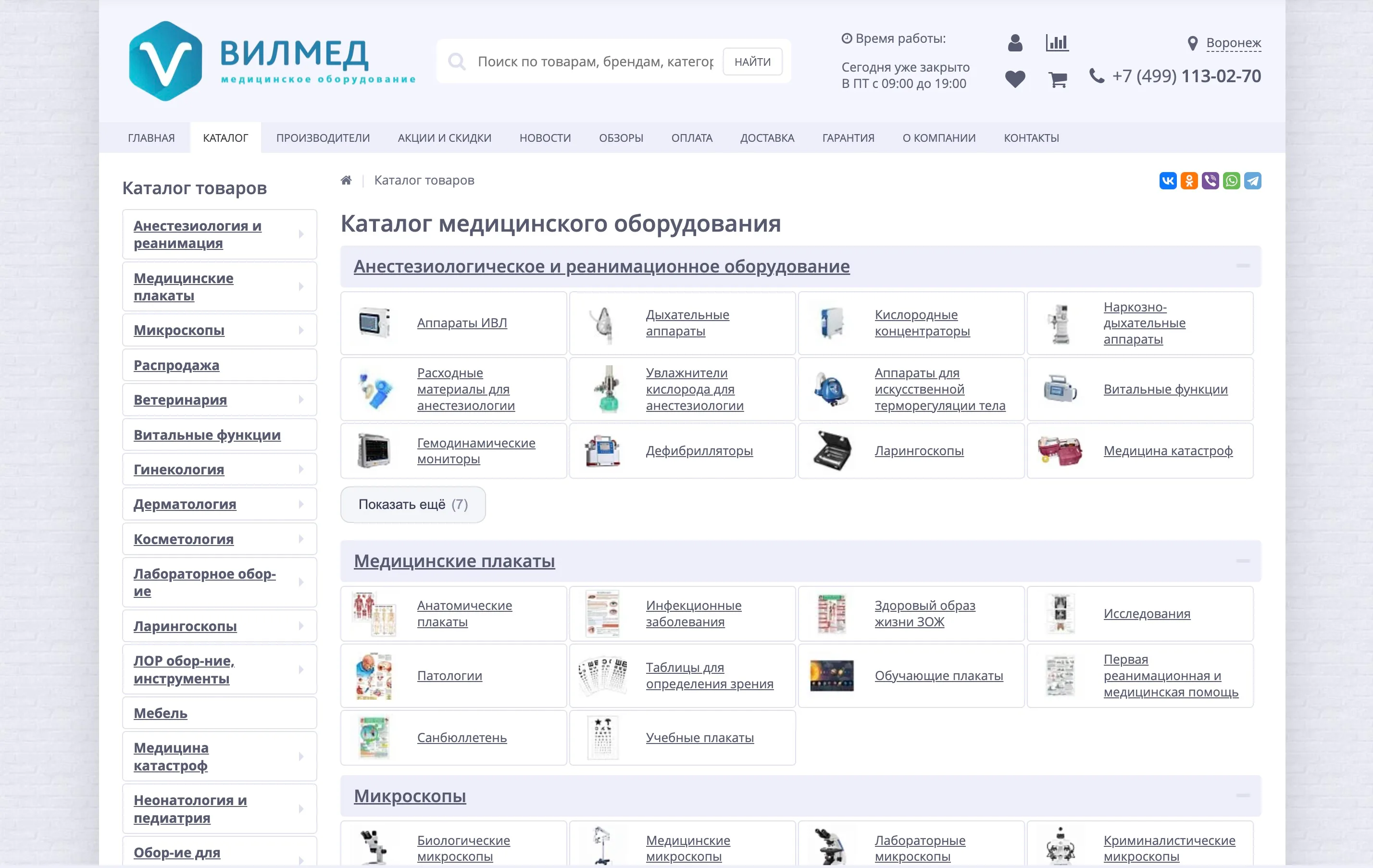
VILMED storefront improvements
Ongoing work on a large medical-equipment store on Bitrix: sticky header and smart search, catalog and product-card UX, SEO filters, ERP sync, composite/Brotli, and a shell cleanup. Live at vilmed.ru.
View case →
55,000+ SKUs in the catalog
KosmaMed (formerly MedMarket)
KosmaMed online store
We run a large medical-equipment store on Bitrix: MedMarket→KosmaMed rebrand, domain migration with 301s, speed (no RAND, composite, WebP), MoySklad/ERP/carriers. Live at kosmamed.ru.
View case →
~1,900 SKUs in the catalog
Oftalmag
Oftalmag online store
We run an ophthalmology-equipment store on Bitrix (enext): Heine/KaWe/Riester catalog, “request a price”, city picker, account SEF. Live at oftalmag.ru.
View case →